
01
If a client complained tomorrow, would your documentation protect you?
No course can guarantee protection. Clear records can help a later reviewer understand what you assessed, discussed, decided and did.
Clinical record-keeping course · Instant access
£9 course + toolkit
Full mini course + nine clinic-ready tools. One £9 payment.
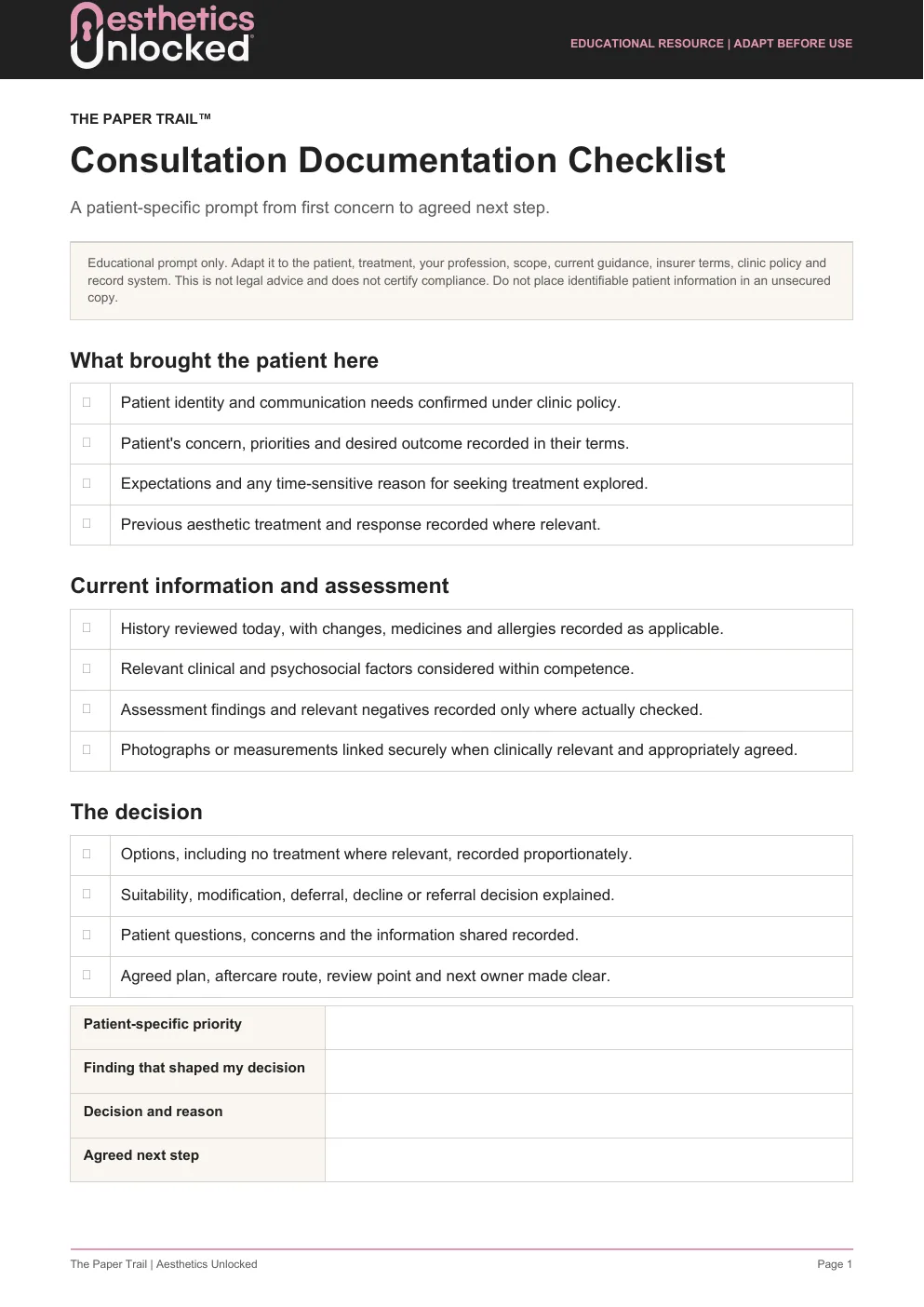
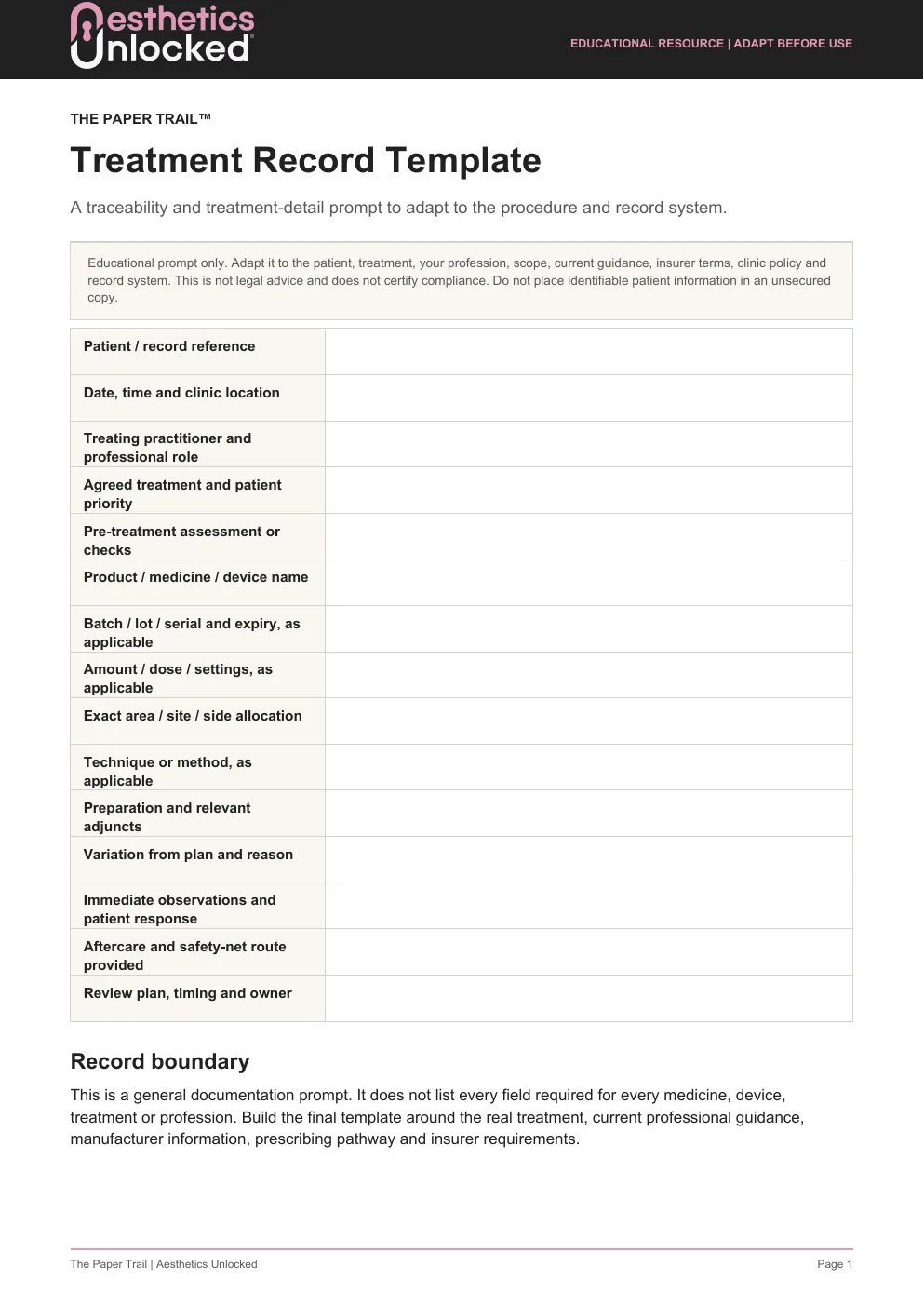
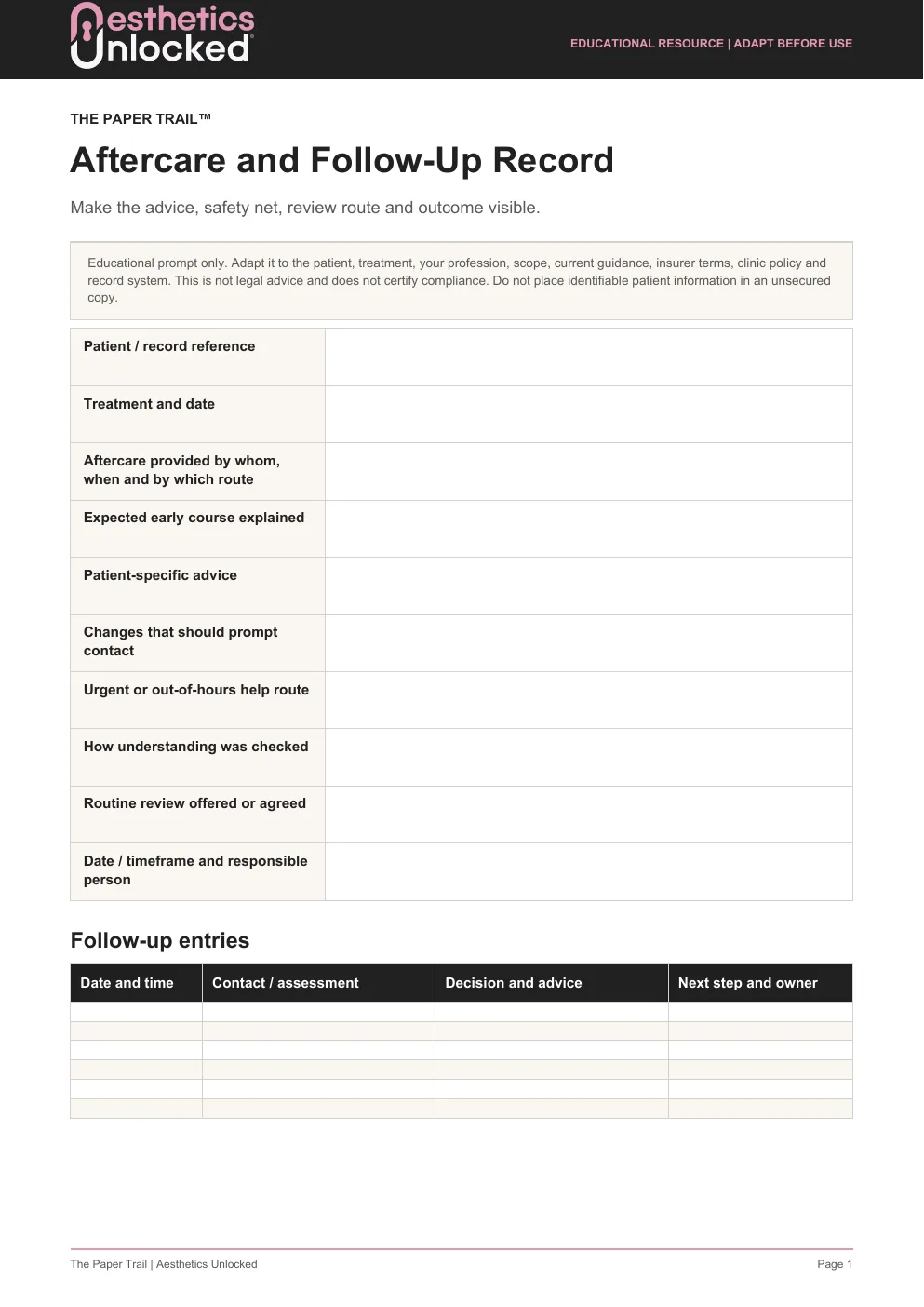
The templates and prompts included in the toolkit
The complete 45 to 60 minute course, plus editable checklists, treatment records, consent prompts, incident documentation and follow-up forms. One £9 payment.
Instant access · Lifetime access · No subscription

Five reasons to look again
01
No course can guarantee protection. Clear records can help a later reviewer understand what you assessed, discussed, decided and did.
02
03
04
05
A familiar shorthand phrase, not a literal statement of law. The practical point is that a later reviewer can only work with what the record demonstrates.
The transformation
Knowing you had a careful consultation, but recording only a conclusion.
A concise clinical story showing what you assessed, thought, decided and advised.
Generic phrases such as consent obtained, risks discussed and patient happy.
Patient-specific notes that make the meaningful conversation and decision visible.
Messages, photographs and telephone advice sitting outside the main record.
A connected chronology with an owner, safety net and clear next step.
A vague sense that your notes could be better.
A twelve-domain audit score and one practical improvement to use tomorrow.
Inside the lesson
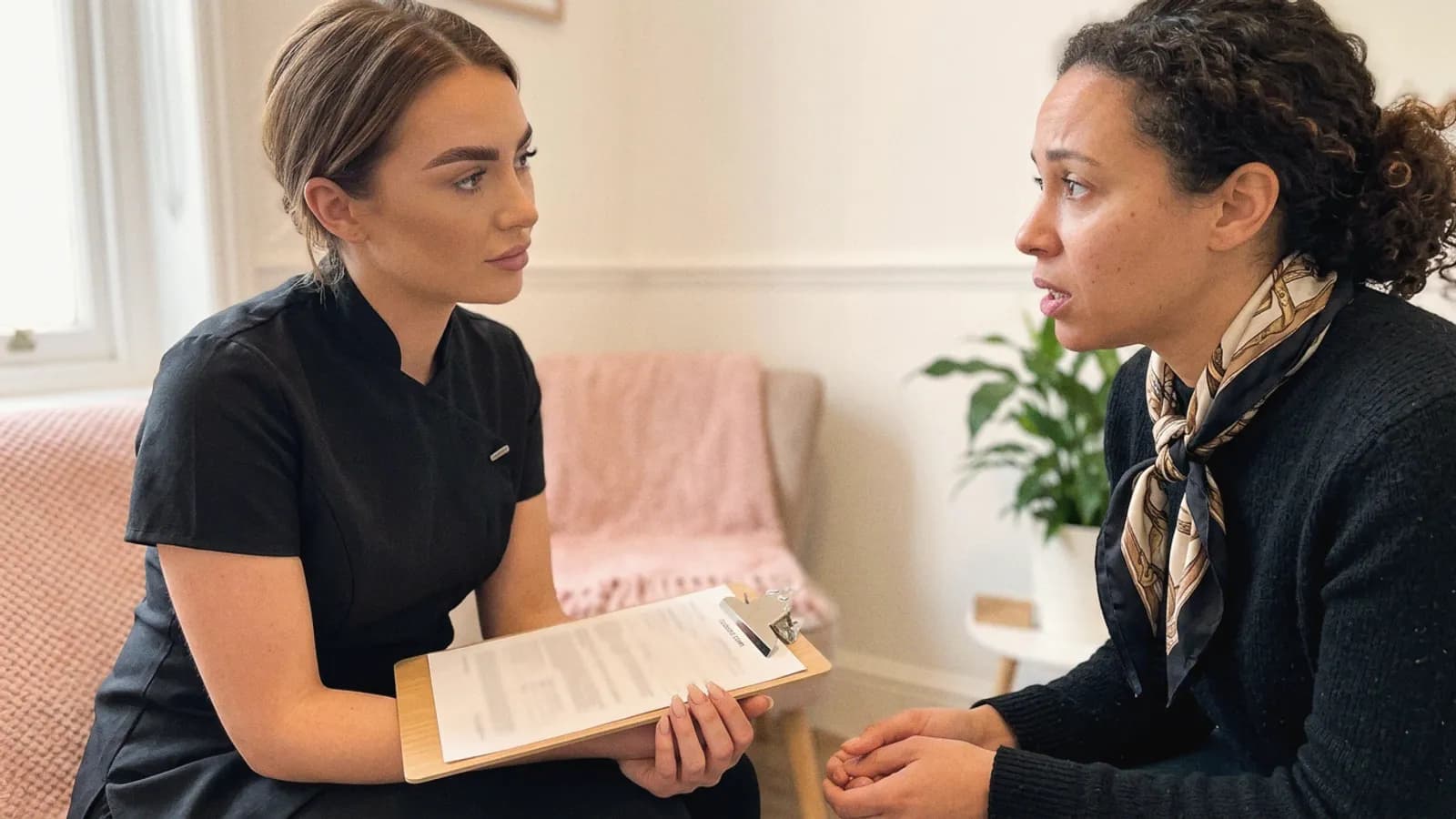
Each lesson runs as a clean editorial article and ends with the next lesson cued up. Mobile-first between consultations and keyboard-navigable at your desk.
What you’ll learn

The curriculum
See the record through an Expert Nurse Witness lens and understand the difference between remembering what happened and demonstrating it.
Connect consultation, assessment, decisions, consent, treatment, aftercare and follow-up without writing a novel.
Record why you proceeded, modified, deferred, declined, referred or arranged review using a four-line reasoning frame.
Make the patient-specific consent conversation visible, including risks, expectations, limitations, alternatives, questions and understanding.
Use a calm five-part framework for unexpected outcomes, concerns, complaints, messages, advice, escalation and follow-up.
Score a fictional aesthetic record across twelve domains, compare the answer key and identify the first improvement for your own clinic.
Why I teach this
Nurse, senior lecturer and founder of award-winning Visage Aesthetics. I have more than twenty years of nursing experience, I am an Advanced Nurse Practitioner and Independent Prescriber, and I have worked in aesthetics for more than ten years.
Recognised by the industry
Business Awards UK
Beauty & Aesthetics Awards
Health, Beauty & Wellness AwardsFounder, Visage Aesthetics

What’s included

Frequently asked
No. It is professional education about clinical documentation. You must follow the current standards for your profession, insurer terms, clinic policies and advice specific to your circumstances.
It is written for UK aesthetic practitioners, especially nurses, doctors, dentists and other appropriately qualified professionals. England-specific CQC context is clearly labelled and does not assume every aesthetic service is regulated in the same way.
No. It helps you test whether your present system captures a coherent patient-specific story. The downloads are prompts to adapt, not universal clinical forms.
No. The course includes a scored knowledge check and completion record, but it does not currently include a CPD, accreditation or course certificate.
Six concise teaching modules, the fictional Expert Witness Documentation Audit, The Paper Trail Checklist, nine practical clinic templates and prompt sheets, ten documentation red flags with stronger alternatives, and a scenario-based knowledge check with answer explanations.
For life. The Paper Trail comes with lifetime access to the complete course and resources. It takes 45 to 60 minutes in total, at your own pace.
Our terms say: “Course enrolments are non-refundable. You're paying for lifetime access to the content as it exists at the point of purchase, plus every future update at no additional cost. Take a free taster first if you want to be sure the teaching style fits before you commit. If something genuinely goes wrong with your access, email hello@aunlock.co.uk and I'll make it right.” Read the full terms.
Most aesthetic practices keep records for eight years from the date of the last entry, in line with NHS Records Management guidance and BMA advice. For patients treated as minors, keep them until the patient turns 25, or for eight years from the last entry, whichever is later. Write the retention period and its basis into a records management policy. More in the Journal: Record Keeping in Aesthetic Practice: UK Requirements 2026.
No. A signed form is evidence that a conversation took place, but only if the conversation actually happened. Both the GMC and the JCCP/CPSA Code of Practice require a two-stage process: discussion first, documentation second. More in the Journal: Informed Consent for Aesthetic Treatments: What UK Law Requires.
THE PAPER TRAIL™
£9