
Clinical · Self-paced · 11 lessons
Acne Decoded
- Scope
- 11 lessons
- Pace
- Self-paced
- Price
- £150
- Commitment
- ≈ 1 hr/wk · 5 wks
The promise. Stop guessing. Start treating acne with NICE-aligned clinical reasoning you can defend to a GP, an insurer, or a complaint reviewer.
Acne is a chronic inflammatory skin condition. Acne Decoded teaches UK practitioners assessment and NICE-aligned treatment planning without over-treating.
Lifetime access
Self-paced, no expiry.
Updates included
As guidance evolves.
Yours to keep
One-off payment, no rebill.
Counts toward NMC revalidation
CPD hours and a Completion Certificate for your portfolio. How to log this for revalidation.
Training is a professional expense. For working practitioners these courses may count as tax-deductible CPD, so part of the cost could come off your tax bill instead of going to HMRC. Check your own position with your accountant.
Try the teaching first
Start Acne Decoded, The Mini free. No card needed.
Start Acne Decoded, The Mini free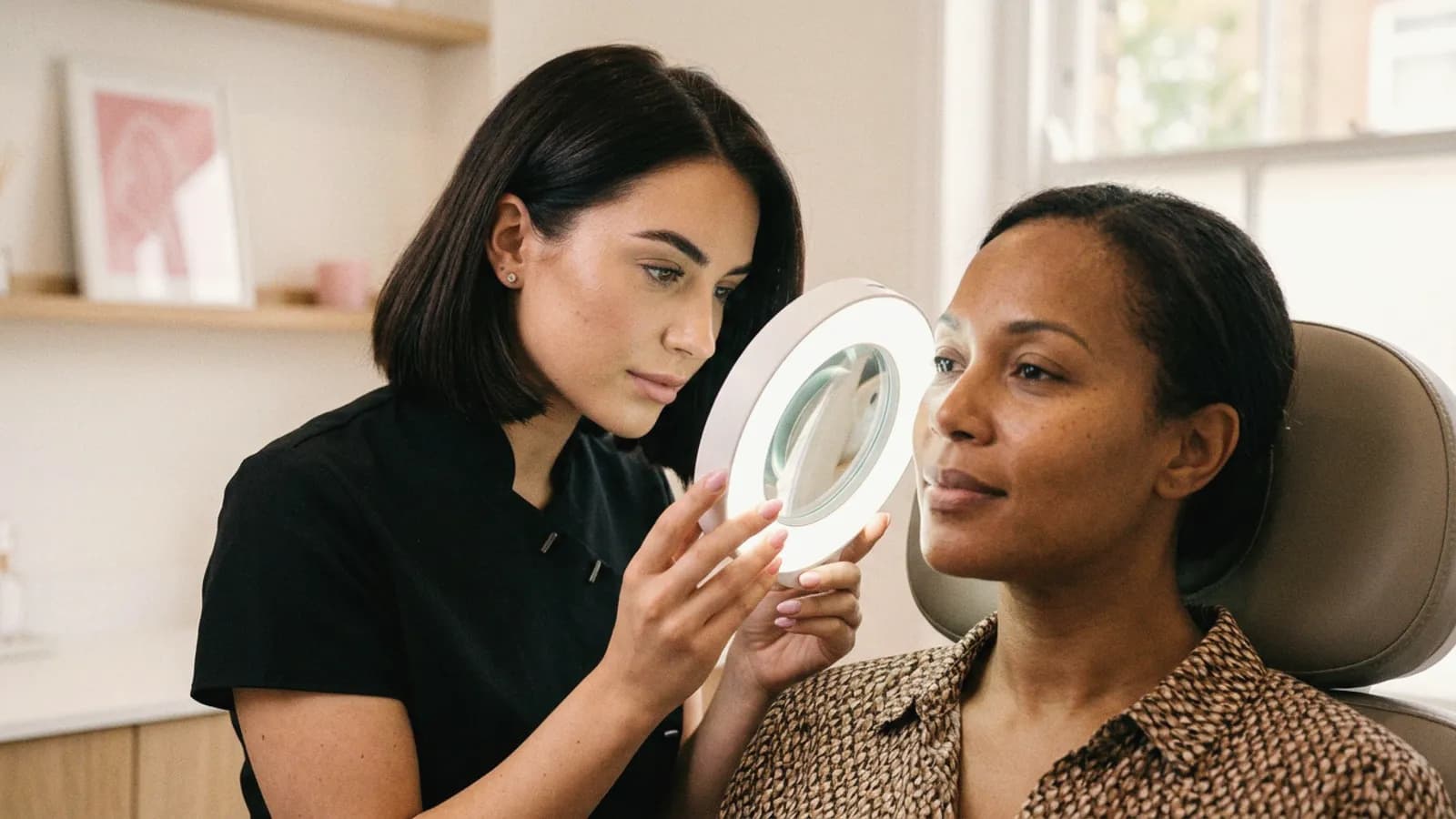
The transformation
Before the course→ after the course.
- Before the course
Treating acne with the same protocol regardless of severity, type, or driver.
After the courseDifferentiating comedonal vs inflammatory vs nodular acne and matching the right pathway to each.
- Before the course
Disappointed clients whose results don't hold past the third treatment.
After the courseRealistic expectations set at the consultation. Treatment plans staged for the long term.
- Before the course
Borrowing protocols from social media. Hoping for the best.
After the courseNICE-aligned, evidence-led decision-making with defensible documentation behind every plan.
- Before the course
Charging beauty-room prices for clinical-level work.
After the courseCharging premium fees with the clinical reasoning to back them, and the photographic documentation to prove the outcome.
Inside the lesson
Editorial lessons, built to be read.
Each lesson runs as a clean editorial article and ends with the next lesson cued up. Mobile-first between consultations and keyboard-navigable at your desk.
- Patient-specific examples and practical prompts
- Per-lesson progress tracking, with the next lesson queued up
- Keyboard navigation for desk study (arrow keys / J–K)
- Calm typography, no auto-play video, no marketing pop-ups
What you’ll learn
The outcomes,not just the topics.
- Acne pathophysiology
- NICE-aligned protocols
- Treatment decision-making
- Severity assessment

The curriculum
11 lessons.Built to ship change.
- 01
What is acne?
Definition, types, UK classification, key facts, and why “teenage acne” gets it wrong.
- Definition of acne vulgaris (medical, not cosmetic)
- Open vs closed comedones
- Inflammatory lesions: papules, pustules, nodules, cysts
- UK classification framework
- Comedonal vs inflammatory acne
- Adult-onset vs adolescent acne
- 02
Anatomy & physiology
Sebaceous gland biology, follicular hyperkeratinisation, microbiome, hormonal drivers. What's happening underneath every breakout.
- Pilosebaceous unit anatomy
- Stratum corneum & barrier function
- Four core pathophysiological drivers
- Comedogenesis (microcomedone formation)
- Cutibacterium acnes colonisation
- Inflammatory & immune response cascade
- 03
Causes & risk factors
Modifiable vs non-modifiable drivers. The lifestyle, hormonal, and pharmaceutical triggers behind most adult-onset cases.
- Hormonal drivers (androgens, PCOS, menstrual, perimenopause)
- Excess sebum production
- Abnormal keratinisation
- C. acnes microbiome imbalance
- Genetic predisposition
- Lifestyle & environmental contributors (stress, occlusion, pollution)
- 04
Risk & complications
Scarring, post-inflammatory hyperpigmentation, psychological impact. Red flags and when to refer up.
- Persistent inflammation & dermal damage
- Skin barrier damage from over-treatment
- Post-inflammatory hyperpigmentation (PIH)
- Atrophic vs hypertrophic scarring
- Psychological & emotional risk indicators
- Red flags: when to refer
- 05
Clinical assessment
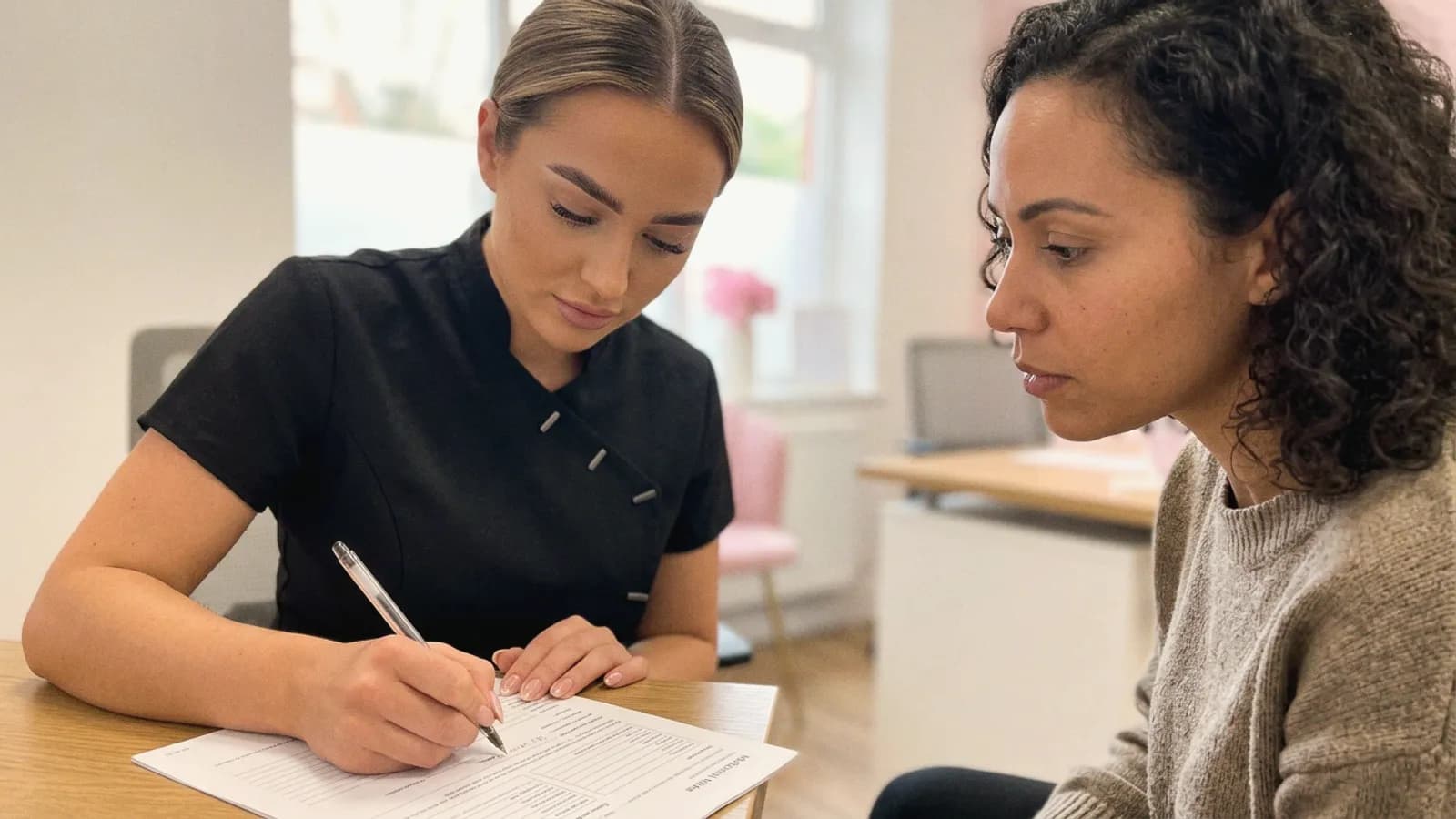
The consultation that surfaces the right history, sets realistic expectations, and de-risks the plan from day one.
- Confirming acne vulgaris vs mimickers (rosacea, folliculitis, perioral dermatitis)
- Lesion-type identification
- NICE severity grading (mild / moderate / severe)
- Distribution mapping
- Scarring & PIH/PIE assessment
- Psychosocial impact screening (NICE-emphasised)
- Photographic documentation protocol
- 06
Treatment pathways
Topicals, oral, in-clinic, when each belongs and how to sequence without burning the barrier.
- AHAs (glycolic, lactic, mandelic): mechanism + indications
- BHAs (salicylic): when, why, how
- Retinoid use & sequencing
- Antibacterial + anti-inflammatory topicals
- Oral pathways & prescriber referral
- In-clinic adjuncts (peels, light-based, microneedling)
- When NOT to treat in clinic
- 07
Case studies & applied learning
Real cases, decision walkthroughs. Mild, moderate, severe, what you'd do, why, and what NICE backs.
- Mild comedonal: full pathway walkthrough
- Moderate inflammatory: sequencing decisions
- Severe / scarring risk: escalation triggers
- Hormonal adult acne: assessment + collaboration
- Post-acne hyperpigmentation case
- When to refer to dermatology / GP
- 08
NHS guidance & summary
How NICE pathways map onto private clinic practice. Knowledge check + recap. Certificate of Completion.
- NICE acne guidelines applied to private practice
- Documentation standards that defend a treatment plan
- Final knowledge check
- Certificate of Completion (CPD evidence)
Why I teach this
I’m Bernadette Tobin, RN, MSc.
Nurse, senior lecturer and founder of award-winning Visage Aesthetics. I hold an MSc Advanced Practice (Level 7), I'm NMC registered, I lecture postgraduate clinicians, and I run an award-winning aesthetics clinic, Visage Aesthetics, which won Best Non-Surgical Aesthetics Clinic 2026 (Essex).
Recognised by the industry
- 2026Shortlisted
Independent Education Awards 2026
Business Awards UK
- 2026Nominee
Educator of the Year 2026
Beauty & Aesthetics Awards
- 2026Winner
Best Non-Surgical Aesthetics Clinic 2026 (Essex)
Health, Beauty & Wellness AwardsFounder, Visage Aesthetics

What’s included
Everything thatcomes with enrolment.
- 11 lessons covering pathophysiology, assessment, and treatment
- NICE-aligned consultation framework + severity scoring
- Treatment pathway decision tree (mild / moderate / severe)
- Real case study walkthroughs
See everything included
- Certificate of Completion for CPD evidence
- Lifetime access, including future updates
- Self-paced · self-marked knowledge check

Frequently asked
Before youenrol.
Is this CPD-accredited?
Acne Decoded is designed to count toward CPD evidence and is appropriate as reflective practice for NMC revalidation. The Certificate of Completion at the end gives you the documentation to attach to your portfolio.
Will this teach me to inject?
No. This is clinical reasoning around acne, assessment, treatment decisions, NICE-aligned pathways, when to escalate. Hands-on technical training requires a separate insured pathway.
Do I need to be a nurse to take it?
No. The course is designed for any practitioner working with skin who wants the clinical reasoning behind acne decisions, including aestheticians, beauty therapists, advanced facialists, and prescribing clinicians.
Is it really £150 with no upsells?
Yes. £150 one-time, lifetime access, no upsells inside the course. Bernadette's stance is that clinical education should be priced honestly.
What do I get when I enrol?
Eleven lessons on pathophysiology, assessment and treatment, a NICE-aligned consultation framework with severity scoring, a treatment pathway decision tree for mild, moderate and severe acne, real case study walkthroughs, a self-marked knowledge check and a Certificate of Completion for CPD evidence.
How long do I have access?
For life. Acne Decoded comes with lifetime access, including future updates. It is self-paced, so you can start the day you enrol and work through it at your own speed.
Can I get a refund?
Our terms say: “Course enrolments are non-refundable. You're paying for lifetime access to the content as it exists at the point of purchase, plus every future update at no additional cost. Take a free taster first if you want to be sure the teaching style fits before you commit. If something genuinely goes wrong with your access, email hello@aunlock.co.uk and I'll make it right.” Read the full terms.
Is NICE NG198 mandatory for aesthetic practitioners?
No. NG198 is the NHS clinical reference, not law. Regulators such as the CQC, GMC and NMC treat NICE guidance as the standard a defensible practitioner is expected to know, so working outside the NG198 pathway needs a clear, documented justification. More in the Journal: NICE Acne Guidelines (NG198) for Aesthetic Practitioners.
Where does aesthetic practice sit alongside NG198?
NG198 covers the medical management of active acne. Aesthetic practice works around it: barrier support, sensitive-skin care during medical treatment, and post-acne scar management once active disease is controlled. Active moderate to severe acne is not an aesthetic case under NG198. More in the Journal: NICE Acne Guidelines (NG198) for Aesthetic Practitioners.