
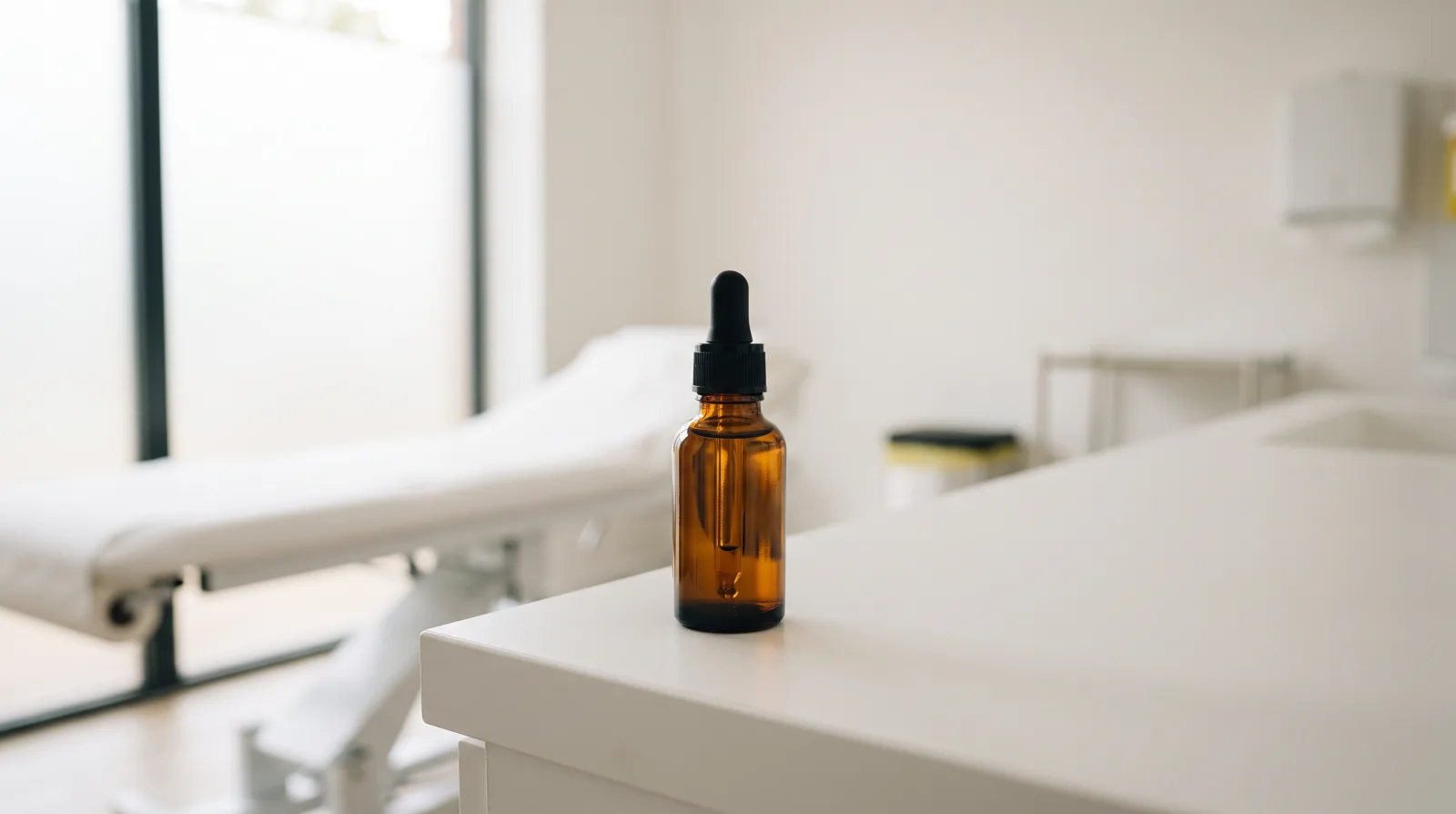
Topical vitamin C (L-ascorbic acid) is among the most evidence-supported cosmeceutical actives available to UK aesthetic practitioners. Peer-reviewed reviews consistently document three mechanisms: reduction of UV-induced pigmentation, support of dermal collagen synthesis, and measurable antioxidant protection against oxidative stress. The evidence is real. So is the complexity of getting the molecule to work once it leaves a clinical-grade formulation and sits on a bathroom shelf.
What topical vitamin C does in the skin
Vitamin C is not one ingredient. In cosmeceuticals it appears in several forms: L-ascorbic acid (the native, bioactive form), ascorbyl glucoside, magnesium ascorbyl phosphate, and tetrahexyldecyl ascorbate, among others. The native form is the one with a direct, well-documented mechanism of action in the published literature.
In the skin, L-ascorbic acid acts through three pathways:
Antioxidant protection. Vitamin C is the principal water-soluble antioxidant in both dermis and epidermis. It neutralises reactive oxygen species (ROS) generated by UV exposure, particularly superoxide radicals and singlet oxygen. This quenching action reduces oxidative damage to collagen fibre networks and keratinocyte DNA.
Melanogenesis inhibition. L-ascorbic acid inhibits tyrosinase at multiple steps in the melanin synthesis pathway. It also reduces pre-formed melanin by converting dopaquinone back to DOPA. The clinical outcome, supported by controlled trials, is a reduction in post-inflammatory hyperpigmentation and solar lentigines.
Collagen synthesis. Vitamin C is an essential cofactor for the hydroxylation of proline and lysine residues during collagen biosynthesis. Without adequate intracellular vitamin C, pro-collagen scaffolding is structurally unstable. Topical delivery at sufficient concentration increases both collagen gene expression and net collagen output in the dermis.
These three mechanisms act independently. The literature supports all three. The practical challenge is delivering the molecule in a stable, bioavailable form.
Where the evidence is strongest
The strongest clinical evidence concerns two outcomes: photoaged skin and pigmentation.
A randomised, double-blind, split-face study published in Experimental Dermatology applied a 5% vitamin C cream to one side of the face for six months. The treated side showed significant improvement in photoaging scores: decreased deep furrows, increased skin microrelief density, and ultrastructural evidence of elastic fibre repair. The placebo side showed no equivalent change.
For photoprotection, a landmark paper published in the Journal of the American Academy of Dermatology demonstrated that combining L-ascorbic acid with alpha-tocopherol (vitamin E) and ferulic acid doubles the photoprotective effect of topical antioxidants alone. The combination also reduced UV-induced apoptosis in keratinocytes. It forms the basis for several high-concentration serums used in clinical practice.
The evidence for vitamin C in pigmentation is consistent with the mechanism. Multiple controlled trials confirm reduced melanin transfer and reduced pigmentation scores at appropriate concentrations. This places vitamin C in the evidence base for managing post-inflammatory hyperpigmentation and melasma, alongside other well-characterised actives.
Formulation: where the evidence diverges from the shelf
This is where clinical vigilance matters most. Many commercial "vitamin C" products do not contain L-ascorbic acid at an effective concentration, at a stable pH, or in a stable vehicle.
Concentration. Effective concentrations in published clinical studies range from 5% to 20%. Below 5%, dermal penetration and tissue saturation are insufficient for measurable effect. Above 20%, irritation increases without proportionate benefit.
pH. L-ascorbic acid is absorbed into the skin in its protonated form, which requires a pH at or below 3.5. At higher pH, it ionises and crosses the stratum corneum poorly. Products formulated above pH 4 to reduce irritation may sacrifice bioavailability for tolerability.
Stability. L-ascorbic acid oxidises rapidly on contact with air, light, and water. Oxidised vitamin C provides no active benefit and produces the yellow-orange discolouration sometimes visible in aged serums. Stabilised derivatives such as ascorbyl glucoside and tetrahexyldecyl ascorbate avoid this, but the published clinical evidence at equivalent concentrations is considerably thinner than for the native form.
Practitioners advising on home skincare regimens should assess these parameters before recommending a product. A formulation labelled "vitamin C" without a declared concentration, known pH, or opaque air-excluding packaging is unlikely to deliver what the clinical evidence supports.
How vitamin C fits into a treatment plan
For practitioners managing hyperpigmentation or post-acne skin concerns, topical vitamin C is a coherent part of the home-care regimen for several reasons.
First, it addresses melanin production upstream, reducing the risk of post-inflammatory hyperpigmentation following procedural interventions such as peels or laser-based treatments. Second, its antioxidant activity complements broad-spectrum SPF, which remains the single most important adjunct to any pigmentation treatment plan. Third, it is well tolerated at appropriate concentrations across most phototypes, though patch testing at high concentrations is advisable on sensitive or reactive skin.
Application timing is clinically relevant. Vitamin C serums applied in the morning, before SPF, maximise the additive antioxidant-plus-photoprotection effect documented in the literature. Evening use is not contraindicated but does not capitalise on the UV-mitigation mechanism.
This is a cosmeceutical claim, not a prescription or medicinal claim. The distinction between cosmetic and medicinal product claims is a regulatory boundary that practitioners must maintain in all client communications and marketing materials. Stating that a cosmetic product "treats" a named medical condition or disease process may cross into medicinal territory under MHRA classification, which requires a product licence. That boundary is not always obvious in practice.
If you are looking for the structured framework for navigating those regulatory boundaries across your whole service offering, the RAG Pathway is the four-week programme that covers where cosmetic, borderline, and prescription product claims sit under current MHRA guidance.
FAQ
Is topical vitamin C evidence-based for use in aesthetic practice?
Yes. Multiple peer-reviewed trials, including randomised controlled studies, confirm efficacy for photoaged skin and hyperpigmentation at appropriate concentrations. The evidence base is most consistent for L-ascorbic acid at 5–20% in a pH-optimised, stable formulation. Stabilised derivatives have a thinner clinical evidence base at equivalent concentrations.
Which form of topical vitamin C has the best evidence?
L-ascorbic acid has the strongest direct clinical evidence. Stabilised derivatives such as ascorbyl glucoside and tetrahexyldecyl ascorbate are better tolerated and more shelf-stable, but published evidence for clinical outcomes at equivalent concentrations is less consistent. Practitioners should assess the evidence for the specific formulation, not the vitamin C category as a whole.
Can vitamin C be used post-procedure?
The evidence supports use of topical antioxidants in post-procedural home care to reduce UV-induced oxidative stress and support barrier recovery. Application timing and concentration should be adjusted to the skin's condition in the days immediately following the procedure. This is a cosmeceutical adjunct, not a substitute for post-procedural clinical management.
Does topical vitamin C work for melasma?
Vitamin C inhibits tyrosinase and reduces melanin transfer, both mechanisms directly relevant to melasma. Controlled trials show measurable reduction in pigmentation scores. It is typically used as part of a broader protocol alongside other actives and rigorous photoprotection, rather than as a standalone treatment.
Is topical vitamin C classed as a medicine by the MHRA?
No. Topical vitamin C in cosmeceutical formulations is a cosmetic product under UK law. Claims must remain cosmetic in character. Practitioners who make claims that a product treats or prevents a named medical condition may inadvertently cross into medicinal territory, which requires a product licence from the MHRA. The cosmetic-to-medicinal boundary is governed by MHRA guidance and is worth understanding before making any skincare recommendation in writing or on your website.